
Fuse Disconnector / Puller
Fuse Combination Switch
Isolator / ATS (3-Pole/4-Pole)
Quick/ Ultra Fast Acting Fuse (AC/DC Type)
Aflex Wheeltronics Pte Ltd is the leading specialist for the provision of various types/brands of Fuse Disconnector/Puller, Fuse Combination Switch, Isolator/ATS & Quick/Ultra Fast Acting Fuse (AC/DC Type) and we have the immediate stock in our warehouse.
Advantages
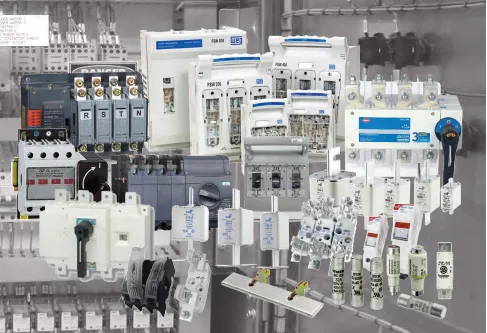
Aflex Wheeltronics is a stockist of AC, DC and HRC fuses, fuse disconnectors, fuse combination switches, isolators and ATS (3-pole and 4-pole). We keep immediate stock in our Singapore warehouse for industrial and marine customers, so a blown fuse does not keep your equipment down for long.
| Product | What it does | Typical use |
|---|---|---|
| HRC (high rupturing capacity) fuses | Safely break very high fault currents without exploding | Distribution boards, motor circuits, industrial panels |
| Quick-acting fuses (AC/DC) | Blow fast on overcurrent | Control circuits and sensitive equipment |
| Ultra-fast (semiconductor) fuses | Clear a fault in milliseconds to protect power electronics | Diodes, thyristors and IGBTs in UPS systems, VSDs and rectifiers |
| DC fuses | Rated to interrupt DC current, which has no natural zero crossing | Battery banks, UPS DC links, DC systems |
| Fuse disconnectors / fuse pullers | Hold the fuse and let it be isolated or changed safely | Switchboards and panels |
| Fuse combination switches, isolators and ATS (3-pole/4-pole) | Combine switching, isolation and fuse protection; ATS transfers load between sources | Main switchboards, generator and dual-supply systems |
Send us the markings on the old fuse (brand, voltage, current, size and part number) and we will match it or offer an equivalent from stock.
Request a fuse quote or call +65 6397 5218.
Fuses are also chosen by their utilisation class, which shows what they are designed to protect:
Choosing the right class, voltage, current and breaking capacity keeps your equipment protected and helps the protective devices in a switchboard work together correctly.
A fuse disconnector holds the fuse links and allows them to be isolated and replaced safely without live parts being exposed. A fuse combination switch combines a load-break switch and fuses in one unit, which saves space in switchboards and gives both switching and short-circuit protection. For dual supplies, an automatic transfer switch (ATS) moves the load between the mains and a generator. Aflex keeps immediate stock of these products in Singapore.
Further reading: Electrical fuses and HRC fuses (Wikipedia)
HRC stands for high rupturing capacity. An HRC fuse can safely interrupt very high fault currents, often many thousands of amps, without bursting. It is widely used in distribution boards, motor circuits and industrial switchboards.
DC current does not pass through zero like AC, so the arc inside a fuse is harder to put out. DC fuses are designed and rated to break DC current safely. Always use a fuse rated for the supply type and voltage of the circuit.
Ultra-fast or semiconductor fuses clear a short circuit in milliseconds. They protect power electronics such as diodes, thyristors and IGBTs inside UPS systems, variable speed drives and rectifiers, which would be damaged by a slower fuse.


