
By Aflex Wheeltronics team
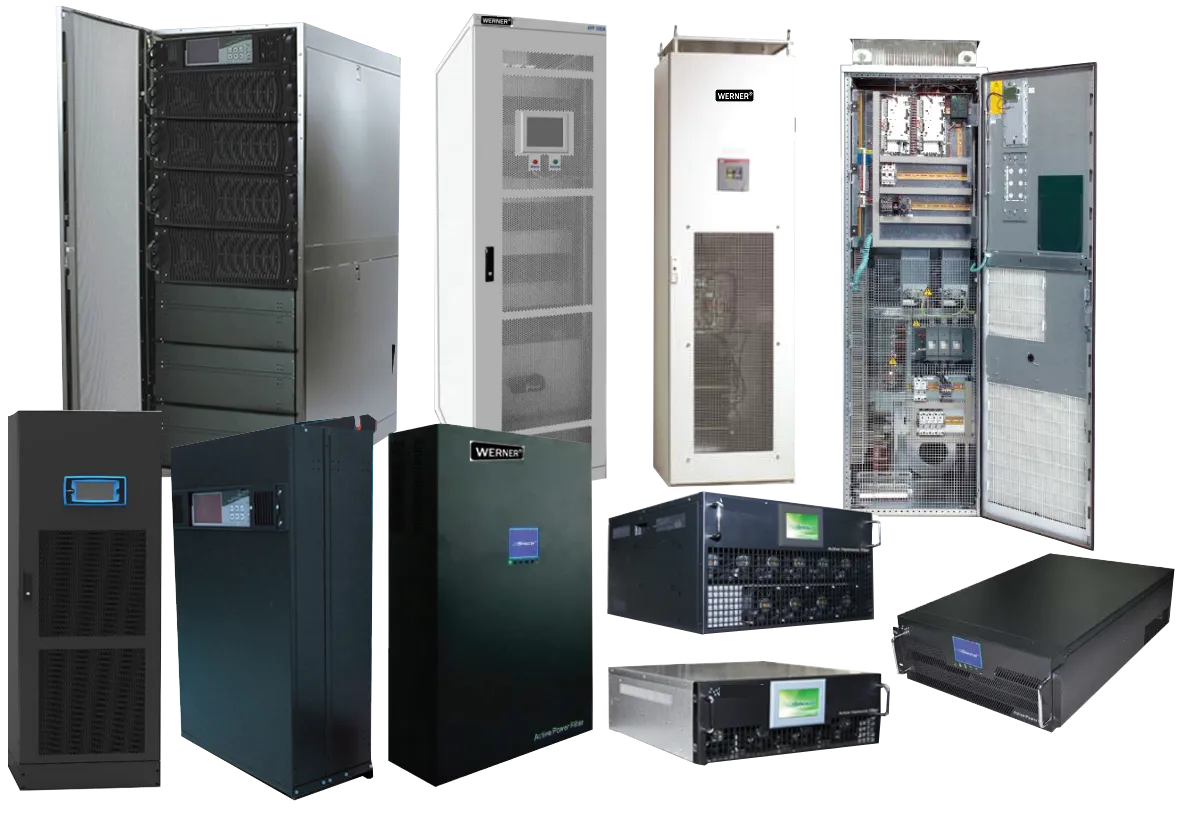
Modern buildings and factories are full of equipment with power electronics: variable speed drives, UPS systems, LED lighting, servers, chargers and lifts. These loads draw current in short pulses instead of a smooth sine wave. The result is harmonic distortion, which can overheat equipment, trip breakers and waste energy. This guide explains what harmonics are, the warning signs, and when an active harmonic filter is the right fix.
In Singapore the mains supply runs at 50 Hz. Non-linear loads draw extra currents at multiples of that frequency: 150 Hz (3rd harmonic), 250 Hz (5th), 350 Hz (7th) and so on. These harmonic currents do no useful work, but they still heat cables, transformers and motors, and they distort the voltage for every other load on the same supply.
Power quality engineers measure this as THDi (total harmonic distortion of current) and THDv (of voltage). Many projects follow limits based on IEEE 519 or IEC 61000, and the building owner or utility may set its own limits at the point of connection.
| Load | Typical harmonic orders |
|---|---|
| 6-pulse variable speed drives (VSD/VFD) | 5th, 7th, 11th, 13th |
| UPS systems and rectifiers | 5th, 7th, 11th |
| IT equipment, servers, LED drivers (single-phase) | 3rd, with high neutral current |
| EV chargers and battery chargers | 5th, 7th |
| Welding machines and induction heating | Wide range, fluctuating |
| Active harmonic filter | Passive filter | |
|---|---|---|
| How it works | Measures current and injects an opposite current | Fixed inductor-capacitor circuit tuned to set frequencies |
| Load changes | Adapts automatically | Performance drops if the load changes |
| Harmonic orders | Many orders at once (typically up to the 50th) | One or two tuned orders |
| Resonance risk | Very low | Can resonate with the network |
| Power factor | Can also correct power factor and balance phases | Fixed reactive power |
| Best for | Mixed and changing loads, commercial buildings, data rooms | Large single loads with a stable profile |
Aflex Wheeltronics supplies 3-phase active harmonic filters for 380–690Vac systems, from 25A to 150A per unit, together with AC and DC capacitors for power factor correction. Contact us with your single-line diagram or power quality readings for sizing advice.
Related: Active harmonic filters · UPS systems · Harmonics in electrical power (Wikipedia)
A passive filter is a fixed inductor-capacitor circuit tuned to one or two harmonic frequencies. An active harmonic filter measures the current continuously and injects an opposite current, so it adapts to changing loads and cancels many harmonic orders at once.
Start from a power quality measurement. The filter rating should cover the harmonic current, which is roughly the load current multiplied by the current distortion (THDi), plus a safety margin for future load growth.
Yes. Most active harmonic filters can also compensate reactive power and balance load between phases, as long as the unit has enough current rating left after harmonic correction.