
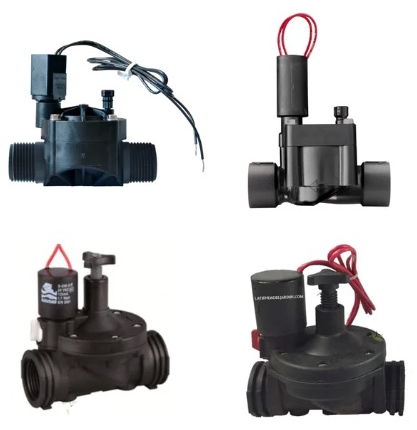
Solenoid valves are used wherever water or another fluid needs to be switched on and off automatically, for example in pump control panels, water tanks, leak shut-off systems and drainage systems. Send us the coil voltage, pipe size, body material and medium you need, and we will advise on a suitable valve.
| Coil voltage | Power type | Typical use |
|---|---|---|
| 12V DC | Low-voltage DC | Battery or solar systems, small control panels |
| 24V DC | Low-voltage DC | Industrial control panels and PLCs |
| 24V AC | Low-voltage AC | Irrigation and HVAC controls |
| 230V AC | Mains AC | Direct connection to the building supply |
Always match the coil voltage and type (AC or DC) to the control circuit. A DC coil on an AC supply, or a 24V coil on 230V, will fail.
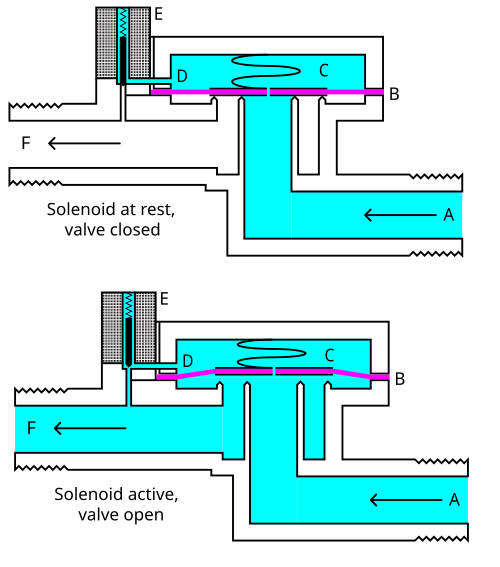
Direct-acting valves work from zero pressure and suit small flows. Pilot-operated (servo-assisted) valves use line pressure to open, so they handle larger flows but need a minimum pressure difference to work.
Request a quote or call +65 6397 5218.
A solenoid valve has two main parts: the electromagnetic coil and the valve body. When current flows through the coil, it creates a magnetic field that lifts a plunger (armature). In a normally closed valve, lifting the plunger opens the orifice and lets the fluid flow; when the power is switched off, a spring pushes the plunger back and the valve closes. In a normally open valve, the action is reversed.
| AC coil (e.g. 24V AC, 230V AC) | DC coil (e.g. 12V DC, 24V DC) | |
|---|---|---|
| Power source | Mains or AC transformer | Battery, solar, DC power supply or PLC output |
| Inrush current | Higher current at switch-on | Steady current |
| Noise | May hum slightly | Quiet |
| Typical use | Building water systems, irrigation | Control panels, automation, vehicles, remote sites |
Fitting a strainer before the valve and choosing the correct coil voltage prevent most of these problems.
Brass bodies are common for water and air. Stainless steel suits aggressive liquids, food and high-hygiene uses. Plastic bodies are used for irrigation and some chemicals. Seal materials such as NBR, EPDM or FKM must suit the fluid and its temperature.
One of the most useful applications of a solenoid valve in a building is automatic water shut-off. A solenoid valve on the main water supply to a pantry, plant room or server room area can be connected to a water leakage alarm. When a sensor detects water, the alarm controller switches the valve and stops the supply, limiting damage until a technician arrives. This setup is common under air-conditioning units, in pantries and in rooms with sensitive electrical equipment.
Further reading: Solenoid valve (Wikipedia)
Choose the coil voltage that matches your control circuit: 12V or 24V DC for control panels, PLCs, battery or solar systems, and 230V AC for direct connection to the mains supply.
A normally closed valve stays shut without power and opens when energised. A normally open valve stays open without power and closes when energised.
Yes. A normally open or normally closed solenoid valve can be wired to a leak alarm system so the water supply is shut off automatically when a water leakage sensor detects water.
